
When the official 2018 World Cup logo, a logo that reflected the Russian people’s heart and soul according to FIFA’s president, Sepp Blatter, was revealed in Moscow on the 28th of October, the countdown to the World’s biggest sporting event finally began. In an interview with FIFA’s official website, Russia’s minister of sport, Vitaly Mutko, stated earlier that “winning the right to host the FIFA World Cup was a dream come true for millions of Russians.” Unfortunately, the World Cup may very well turn into a footballing nightmare for the Russians, who have officially made clear their very high ambitions for the national team and its Italian coach, Fabio Capello.”
When Capello was hired back in July 2012, his first task as the coach of Russian national team was to qualify them for their first World Cup in 12 years’ time, and, in the longer term, to bring glory to the country at the World Cup tournament on home soil in 2018. Capello solved the first equation perfectly, since Russia won their qualification group ahead of Portugal, but, ever since then the magic has disappeared. The tournament in Brazil was a huge disappointment, during which the Russian players never managed to show the World what they were capable of.Capello was obviously not prepared to bet on the offensive aces Alan Dzagoev and Aleksandr Kerzhakov, which meant that Russia’s offense was tame and uninspiring throughout most of the tournament. Instead of using the offensive quality the squad had, Capello decided to put all his eggs in the defensive basket, containing the experienced CSKA Moscow trio Igor Akinfeev, Sergei Ignashevich and Vasili Berezutski; Capello’s main objective cleary was to avoid letting goals in, and this could actually have worked fine had the goalkeeper Akinfeev played on his regular high level.
Unfortunately, Akinfeev played a horrible tournament, and the World Cup ended after three boring games. This caused the national team to lose most of the support it had before the players left for Brazil. Only 3500 spectators showed for Russia’s first home game after the World Cup, when they faced Azerbaijan, and this was the lowest attendance for a home game since 1992. The disappointing World Cup also caused a discussion between the Russian football fans and the media as to whether or not Capello was the right man for the job, and Capello himself is also considering quitting his job because of disputes with the Russian Football Union. Capello became one of the World’s best paid coaches back in January, when he extended his contract to 2018, but he has not been paid in the last five months and he is, according to himself, very close to “changing his behavior” towards the Football Union.
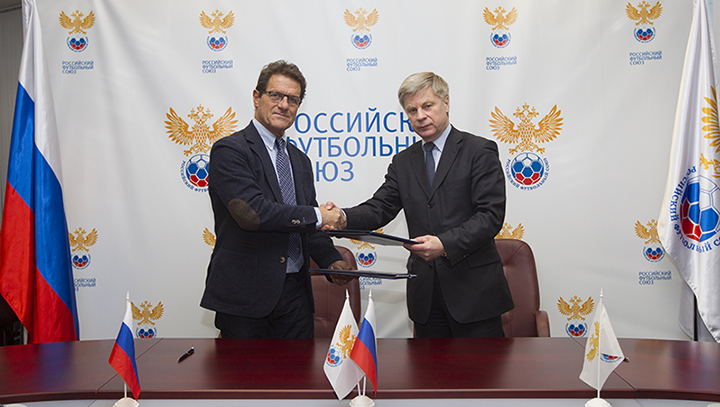
Capello with the head of the Russian Football Union Nikolai Tolstykh after Capello extended his contract.
Capello is not the biggest problem
A highly paid, foreign coach such as Capello is the obvious target when the results fail to meet the expectations, but Russia’s problems are far bigger than Capello’s defensive tactics and strict management style. Capello has, ever since he was hired, advocated for an expansion of the Russian Premier League,for a modification to the league’s limit on foreign players and for the possibility of nationalizing foreign talents. Several times, he stated that one of the biggest issues the few Russian players getting regular playing time in the RPL. After Russia’s draw with South Korea this summer he told the paper Sport-Express: “I need help from the Federation. This applies to the limit on foreign players. At the moment a team can play seven foreigners at a time, so I only have a choice of 64 players for the Russia national team.” The 64 players are from 16 RPL clubs, who often play with four Russians and seven foreigners, due to the so-called 7+4 rule that forces clubs to have at least four Russians on the pitch at all times.
It is no secret that rich Russian club owners tend to chase quick success by signing expensive foreign players. This trend gave rise to a fear regarding the possibility of the league being flooded by foreigners, which led the Russian Football Union to introduce the 6+5 rule, later changed to 7+4, to make sure that clubs did not forget the Russian players. Unfortunately this action had some unforeseen consequences, as the restrictions removed a lot of the competition within the squads, since Russian players were suddenly able to take their spots in the starting lineup for granted. Most people with some insight on this beautiful game know how important it is to always be pushed forward to develop and that those players who are not being pushed to their limit often become lazy. A place where this particular rule change did create competition was the transfer market. The best Russian players suddenly became highly desired and this made their prices and salaries fly through the roof, to a level that was way too high compared to the players’ actual skills.
It is obvious that the Russian players have been benefiting from the 7+4 rule, but it has not helped the clubs or the national team. The high salaries in the Russian Premier League remove the players’ economic incentive to move abroad. After Russia’s incredible 2008 EURO campaign a wave of Russian stars like Diniyar Bilyaletdinov, Andrey Arshavin and Pavel Pavlyuchenko exchanged Russia for the English Premier League but they quickly crawled back home. Since then very few Russian players have left their home country and none of those who left were among the stars of the Premier Leagues, which means that talented players like CSKA Moscows Alan Dzagoev and Dynamo Moscows Aleksandr Kokorin still play in Russia. They both have the talent to play for Europe’s best leagues, but their high salaries scare the otherwise obvious transit clubs away. It is difficult to blame the players for refusing to accept a pay cut and leave their families and stardom at the same time for a mid-table club in Western Europe. The fact that Russians stars stay home definitely strengthens the league, but it is a huge problem for the national team. The problem is that players do not develop as much as they would in an even bigger league, where they would face stronger opponents every week. Fabio Capello is also aware of this problem and he tries to persuade his players to leave the comfort of the Russian Premier League. After Russia’s defeat to Belgium in the World Cup he said: “I think that playing abroad helps everyone mature and improve” when he was asked to comment on the fact that every member of his 23 men squad played in their homeland.
Andrey Arshavin and Roman Pavlyuchenko both left Russia in exchange for London, when they sign with Arsenal and Tottenham.
Even though Russian clubs have invested exorbitant amounts in foreign stars over the last 10-15 years, the Russian Premier League is still significant weaker than its Western European competitors. One of the reasons is the huge difference between the richest (and best) clubs and the rest, which causes the pace and intensity of the league to be much lower than in the rest of Europe. At both the World Cup and in European competitions it has been obvious that Russian-based players are used to have more time with the ball without pressure and to play at a slower pace. This has caused big and ambitious clubs like Zenit St. Petersburg, Spartak Moscow and CSKA, but also the national team, to suffer embarrassing defeats to weaker opponents. This is not only a problem for the Russian players, but also for the foreigners in the league like Zenit’s Brazilian striker Hulk, who was awful during the World Cup even though he played a great season for Zenit.
After several discussions between the clubs and the Russian Football Union it finally looks like the 7+4 rule will be changed beginning next season. It will be replaced by a so-called 10+15 rule, where the clubs can play with whoever they want in the starting lineup, but they may only register ten foreign players for their 25 man first team squad. I doubt this will solve Capello’s problems with the small sample of players, but it will most likely help him and the Russian football world in other ways.
With the 10+15 rule some of the earlier mentioned problems can be removed. Russian players will of course still be attractive, but the salaries should, over time, decrease to a more realistic level, which will make players interesting for foreign clubs again. Unfortunately, this new rule also opens the possibility for coaches to use ten foreign players in the starting lineup, meaning that even fewer Russian players will get regular time on the pitch. The good thing about this threat is that it will raise competition in the squads, because the Russian players are now challenged for their place in the starting lineup. This will, without doubt, help develop the players, especially if they manage to keep their name on the team sheet.
Where are the young players?
With only four years until the World Cup tournament, the majority of the 2018-squad is most likely already in the league or, at least, very close. We might see a player or two who are 16-17 years old today break through before the tournament, but right now it still looks now unlikely. Even though the Russian people have a giant passion, for football it is difficult for young players to break through in the Premier League.
Back in 2006, Russia won the U/17 EURO in a tournament that contained stars like the Belgian Axel Witsel, the Germans Toni Kroos and Marko Marin, Spain’s Cesar Azpilicueta and several others, who all play at the highest level today. Unlike their opponents, none of the European champions established themselves as stars at the highest level. The most prominent name from the Russian squad was the striker Aleksandr Prudnikov who spends most of his time on Dynamo Moscow’s bench. The 25 year old player has only played 81 minutes this season. The 2006 team’s players should all be established by now, but unfortunately they just prove how difficult young, and talented, Russian footballers have it when they get closer to the big dogs.
At this moment, is it difficult to see any young players that may help Russia fulfill their 2018 goal. Only 28 players under the age of 24 with a Russian passport have played in the league this season, and none of them have been on the pitch every round. In comparison, 120 under-24 Dutchmen played in the Dutch Eresdivisie and 80 Spanish youngsters played in the Spanish La Liga. Luckily there are bright lights ahead like Rubin Kazan’s promising trio composed of midfielder Magomed Ozdoev, defender Elmir Nabiullin and winger Maksim Kanunnikov, who are all among the clubs best players. These stories are, unluckily, far apart and the top scorer of the Russian U/21 national team, Konstantin Bazelyuk from CSKA, has, for example, only played some measly eight minutes this season despite his status as a highly promising player, while the 21 year old midfielder Pavel Mogilevets, who was awarded a spot in the World Cup squad after a wonderful spring season for Rubin Kazan last season, has only played 88 minutes for Zenit since he returned to the club in September.
There are a lot of reasons why the young players are not playing, but the most obvious is that they are simply not good enough. Russia lacks modern academies to develop their young players to the level the Premier League clubs need. Apart from that, the development of youngsters lacks the planning and supervision with the talents we have successfully seen in Germany. Among other problems are impatient club owners who do not have the time to develop young talents in their chase for success, and the high salaries who make the players satisfied and lazy, especially when they know how long and difficult the journey to Premier League playing time is. The future national team players are, therefore, already now long behind their peers from other great football nations around the World, something that Capello has also noticed and mentioned. So far, the talent discussion has not been very popular and, instead of discussing how Russia could foster the development of their young players, Mutko and the Russian journalists discuss which Brazilians should be granted Russian passports to strengthen the national team.
___________________________________________________________________________________________________________________________________
Follow Toke Theilade on Twitter: @TokeTheilade

Author: Toke Møller Theilade
Brøndby supporter, groundhopper and more importantly Editor-in-Chief at Russianfootballnews.com. As a hopeless romantic, I still believe Fyodor Smolov and Viktoria Lopyreva has a future together.

Fantastic article Toke. While I agree with the limiting foreign players rule that the RPL has. It does mean the salaries are inflated and stop them going abroad. However, in Soviet times there were good players and the USSR were on of the best teams in the world and nobody really played abroad. However, back then there was a lot of investment in youth sports whereas now, in Capitalism, there is less of a focus on this. Also RPL teams want short term success so sign already established Russian players and European players, thus meaning the young players don’t get so much of a chance. However, by 2018 I think the situation will have improved and there will be more young players in the league. Especially a team like Zenit who are looking to become a top European club, to do this they need a 5* academy. We shall see