
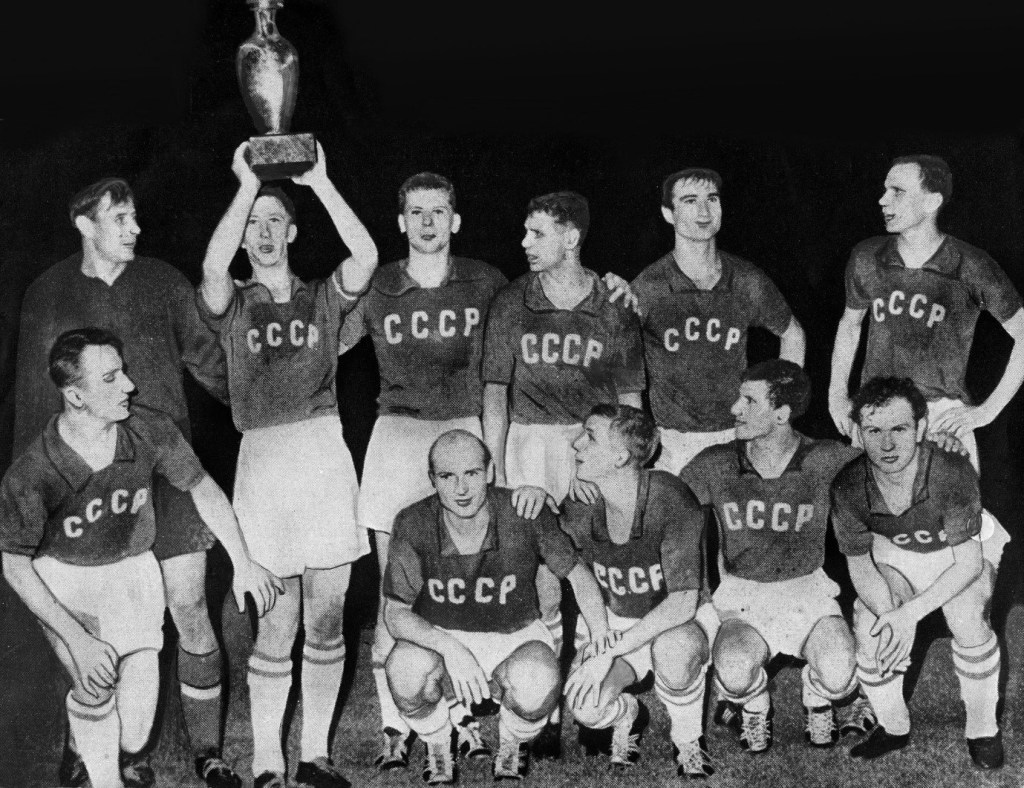
Russia have qualified for Euro 2020, is a host nation and will face off against Belgium, Denmark and Finland. As a result, RFN takes a trip down memory lane to the USSRs only ever international triumph, winning the first-ever Euro Cup in 1960 & finds out what happened to the Starting XI that won the final.
READ MORE: Sbornaya’s Golden Generation and the 1960 European Nations Cup
|
Lev Yashin
The Black Panther is to this day the only goalkeeper in the world to have won the Balon d’Or and is one of the greatest to have featured between the sticks. He continued to play for Sbornaya until 1967, and hung up his boots for good in 1970 having been at Dinamo Moscow for his entire career - a true one-club man who even turned down a move to Real Madrid. After retiring, Yashin held various roles behind the scenes at Dinamo before passing away due to stomach cancer in 1990. He was given a state funeral as a Soviet Honoured Master of Sport.
READ MORE: Lev Yashin: The Black Panther Who Changed the Goalkeeper Position
|
Givi Chokheli
The Georgian native is a legend at Dinamo Tbilisi, having played for the club for a decade and managed them on two different occasions. However, he retired early due to injury and died young at 56. According to temporary reports he used to translate for Mikhail Meshki in public, as Meshki pretended that he could not speak Russian and refused to talk to the press.
|
Anatoly Krutikov
Krutikov was one of the lowest cap-holders of all the side which started the 1960 final, with just nine USSR caps to his name. However, he became more famous for his work at Spartak. Player for a decade and manager for one year in the 70s, he was the director of the academy for eight years in the 1980s and oversaw the development of many youth player who went on to dominate the 90s under Oleg Romantsev.
|
Anatoly Maslenkin
Anatoly Maslenkin was another Spartak legend, having featured for the Red-Whites in two different spells in his career. However, he is arguably most interesting for his lifestyle off the pitch: fluent in English, a keen crossworder, listened to classical music and provided the country with the prodigious talent of Fedor Cherenkov as a coach.
|
Yuri Voynov
Despite being born in Kalinskiy in Moscow Oblast, Voynov spent all his life in Ukraine from 1956, after moving to Dynamo Kyiv and even worked as a PE teacher in a factory. Considered one of the greatest midfielders in the Soviet game, he coached all top three Ukrainian clubs before the fall of the USSR: Dynamo Kyiv, Chernomorets Odessa, and Shakthar Donetsk. In the last 10 years of his life, before his death in 2003, he apparently struggled with depression after the fall of the Union and attempted to commit suicide on numerous occasions.
|
Igor Netto
Team captain, midfield general, and incredible footballer - Netto was ironically nicknamed Goose by his teammates for his long neck and high-pitched hiss whenever anyone gave the ball away. His brother Leo spent eight years in the Gulag, but in the 90s looked after Igor after his wife refused him help. Igor spent much of the end of his life as a relatively forgotten man in almost abject poverty.
READ MORE: Igor Netto – The Greatest Captain of Them All
Valentin Ivanov
Striking partner of the great Eduard Streltsov, Ivanov himself is a legend at Torpedo too went on to have the career many expected Streltsov himself to have - if he was not falsely apprehended in the Gulag. He scored 140 goals in 280 games in 14 years at the club, and then transformed the side as a coach. He’s coached the side on six differing occasions from 1967 to 2003 and led to the side winning the USSR Cup in 1993 and First League in 1976, before his death in just 2011.
READ MORE: Strelec in the Gulag
|
Slava Metreveli
Another Georgian and graduate of Dinamo Tbilisi, Metreveli is likewise another who died young and was largely forgotten about for 30 years. He dedicated much of his life to the sport, returning to Georgia after leaving Torpedo and after retiring from Dinamo Tbilisi in 197, coached the side in 1976. He bought a restaurant in Tbilisi before undergoing serious brain issues in his later years and died aged 61 in 1998 reportedly recognising very few people and able to do very little due to serious Alzheimers.
|
Valentin Bubukin
An interesting character, the former Lokomotiv Moscow attacker moved to CSKA after the Euros at the request of his former coach Vsevolod Bobrov and spent the subsequent 30 years are various clubs (mainly CSKA) as head coach, coach and other roles. After retiring from football, he worked for RZD. Interestingly, he once accidentally caused the death of an Indonesian footballer in the late 1950s after throwing a wet ball of the man’s head when over for a series of friendlies. This morphed into a local legend in Indonesia and the term Bubukin came synonymous with a “mysterious Russian footballer with an Iron Foot” and a whole brand of men’s hygiene products arose as a result.
|
Mikhail Meshki
Meshki spent his whole career in Tbilisi, for both Dinamo and Lokomotiv. Afterward, he moved to the Avaza Specialized Children’s Football School and taught young kids in the capital how to play until his death in 1991. In 1998, he was voted as the best player in the history of Georgian football.
|
Viktor Ponedelnik
The former beanpole striker for SKA Rostov-on-Don is the only surviving member of the 1960 Euro Cup-winning team after the death of Anatoly Krutikov last month. He played for SKA, Spartak, and CSKA after the Euros and retired in 1966. After this, following in his fathers’ footsteps he moved into journalism and wrote about Russian football until beyond the turn of the Century.


Leave a Reply