
The 2014/15 season has seen a dramatic change in fortunes for Tatarstan based club Rubin Kazan. The former Champions League contenders had their worst season for seven years in 2014, finishing in 9th place, and sacking legendary long term manager Kurban Berdyev after 11 years and two league titles with the club, in the process. The departure of Berdyev would spell the end of several high profile players at Rubin – mostly down to financial restrictions, and also partly down to not having Berdyev in charge anymore, and in the 6 months following, Rondon, Natkho, Eremenko and M’Vila all departed. Many believed Rubin would struggle in the aftermath, with Rondon’s goals and Natkho’s dictation of play so crucial to Rubin in the months previous – Rondon was amongst the top scorers at the time of his big money departure to league rivals Zenit – but struggle they did not.
New manager Rinat Bilyaletdinov came in. His previous role was as youth coach at Lokomotiv Moscow, and with him came new ideologies and inexperience. While Rubin’s form improved in the 2nd half of the season, Rinat’s inexperience showed at times, and poor decisions with introducing young players too early, or experimenting with them in different positions cost Rubin points at time. Some of his experiments paid off however, with teenagers Elmir Nabiullin and Sardar Azmoun establishing themselves as regulars at left back and up front respectively, keeping out international stars such as Marko Devic, and French U21 left back Chris Mavinga.
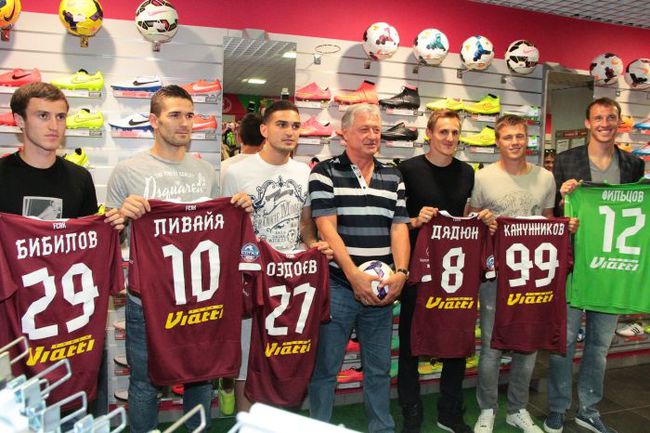
The summer gave Rinat the chance to really evaluate the squad and make it his own, though financial restrictions put in place when Berdyev left meant he had to be cautious in the market. He re-connected with several of his former Lokomotiv youth players, and by the end of the summer, no less than 5 of the squad were players he had worked with back in Moscow (Filtsov, Burlak, Kambolov, Mullin and Ozdoev). The success of these players would vary greatly, but a clear pattern was emerging. Bilyaletdinov was compiling squad largely built around young Russian players, with his Lokomotiv reunion being topped off with the addition of the spritely ex Zenit winger Maxim Kanunnikov. A sprinkling of experience remained though, with the old guard of Ryzhikov, Navas, Kuzmin and Karadeniz being joined by Blagoy Georgiev, to help the squad keep their heads.

Rinat Bilyaletdinov together with his new defender Guillermo Cotugno.
Later in the season, the clubs’ policy was clearly outlined when Bilyaletdinov explained the loan signing of 20 year old Uruguayan defender Guillermo Cotugno in February: “We were looking for a young player who could play several positions in defence and midfield. Cotugno meets these requirements. We had options with young Russian players, but they did not meet the specifics and the prices were high, and so we moved on to South America by reviewing several players from Brazil, Uruguay and Chile. The main specification was to play right-back, but in Cotugno’s short career, he has played centre back, and also at left back.” Cotugno has been somewhat of a revelation since joining, firstly impressing at left back to cover the injured Nabiullin, and then covering astutely at centre back when Cesar Navas was injured. Cotugno is not the first Uruguayan defender to play for Rubin, and already comparisons are being drawn with Andres Scotti, who had a 3 year spell at the club between 2003 and 2006.
The season got off to an awful start, with a 4-0 loss at home on the opening day to Spartak Moscow. New boy Taras Burlak took the blame, and rightly so, being unable to handle man mountain Artem Dzyuba all game. Burlak would only play 90 minutes more for Rubin before being shipped out on loan to 2nd Division Krylia Sovetov, with his poor performances and attitude attributed to his departure according to Bilyaletdinov.
However fortunes would soon change. The opening of the brand new 45,105 capacity Kazan Arena – built for the World Cup in 2018 - would coincide with the rebirth of two players who would turn out to be key in the rest of Rubin’s season. Igor Portnyagin and Carlos Eduardo. The latter is Rubin’s biggest ever transfer, costing them a rumoured €20m in 2010, the former, a 26 year old Russian striker who was more known for his loan journeymanship than goalscoring ability.

Rubin Kazan’s brand new Kazan Arena will be used during the 2018 World Cup.
Portnyagin made his first ever Rubin start in the inaugural game at the Kazan Arena against Rinat’s former club Lokomotiv, despite being on the books of the club for seven years. He would go on to win a penalty which would tie up the game for Rubin, but his overall performance would keep Iranian wonder kid Azmoun out of the line-up until the winter break. A wonderful change of scene for Portnyagin, who didn’t make the first two squads as Bilyaletdinov was unsure whether to sell him or not, having received a €1m bid from Tom Tomsk. At the time of writing, Portnyagin is the league’s 2nd top scorer on 11 goals, and has made his Russian National Team debut, along with Kambolov and Nabiullin. In fact for the first time ever, Rubin had 5 players on the field for Russia’s national team at the same time, a credit to the excellent work shown in the season so far.
Eduardo was reintroduced to the team for the following game against CSKA. After struggling in his early years at Rubin, with form and injuries, he went to Brazil on loan and also struggled greatly there, putting on weight and gaining a poor reputation. During pre-season, Eduardo was dropped to the reserves for attitude problems, but a conversation with Bilyaletdinov changed his ways. Referencing the 7-1 drubbing his fellow countrymen faced in the World Cup to Germany, he inspired him to stop being lazy, and encouraged him to be more of a team player.
These games would begin the run of 7 home games unbeaten, with only 3 losses between then and the winter break coming away to the Krasnodar sides, and finally at home to Zenit who ended Rubin’s unbeaten streak at the new stadium.
A clear change of tactic was in play compared to the days of Berdyev. The Turkmen employed long ball tactics, sitting deep and looking for the out ball to Rondon, or more recently Azmoun. However under Bilyaletdinov, a clear shape and strategy was employed. Fast, counter attacking football, teamed with high pressure. The presence of Portnyagin up front, who shows strength and pace to scare any defender is a huge bonus, providing a target for goal kicks, and a pivot on which the attacking midfielders can work around. The pace and creativity of Eduardo in the central attacking midfield role is key to the team. When he misses games the team loses a dimension. Play becomes slow and they revert to diagonal balls into the box aimed at Portnyagin. While Eduardo’s stats may not seem all that attractive on paper, there are no words to describe how important he is to the team, and when he almost moved to FC Koln in January, the idea of going the rest of the season without him seemed futile.
However it is not only Rubin’s attack which is making a force to be reckoned with. A mix of youth and experience in defence has provided a stern backbone, but the man who stands out, possibly as Rubin’s star player this year, is Solomon Kverkvelia. The Georgian centre back is a 6’5 athletic machine. Named Georgian footballer of the year for 2014, he has come on leaps and bounds since Bilyaletdinov joined. Last season he was compared to Bambi. Lacking balance, strength and composure, but this season, he is a different player completely, holding the Rubin defence together, with a combination of his height, strength, awareness and outstanding pace. For someone of his stature, it seems impossible for him to be able to move so fast, but in games against some of the league fastest players – Ahmed Musa of CSKA stands out – he has shown them a clean pair of heels. Not to mention he has one of the best sliding tackles Kazan has ever seen. Statistically greater than the centre backs for the other teams near the top (below), this boy is certainly built for bigger things.
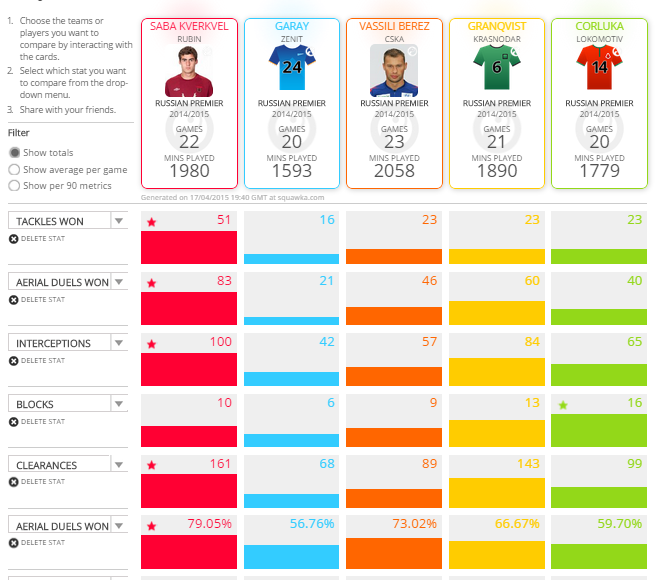
According to Squawka stats, Kverkvelia has the most interceptions in Russia this season, and of all the leagues covered on the site, he ranks 5th in terms of interceptions per game for all players who have played 15 games or more in 2014/15.
There could be pages written about how every Rubin player has played their role in the revitalisation, but it eventually all stems back to the manager. When he came in, many were questioning Bilyaletdinov and his methods, but looking back, they would probably agree they hadn’t given him a chance. His ability to motivate players, as well as his passion to encourage and give chances to Russian youth is a credit to the Russian Premier League, a nation where despite stringent rules, home-grown talent is rarely given a chance.
Rinat and his impact can be summed up perfectly with the following anecdote. After a mid-season friendly in Turkey, Bilyaletdinov was seen having a chat with 17 year old Ilzat Akhmetov. The teenager has had a minor breakthrough in the first team, and is seen as Rubin’s next prodigy. He was overheard telling the boy that he needs to be more clinical with his finishing from outside the box, having missed a couple of chances during the game. Rinat calls over goalkeeper Sergey Ryzhikov and sticks him in goal. He then sets up a drill with Akhmetov, where he feeds the ball into his feet, and instructs him to turn and shoot first time – with the stipulation that neither would leave the pitch until he was able to score past Ryzhikov. Three attempts later, Akhmetov hit the top corner, and Bilyaletdinov strolled off.
This level of dedication is what is putting Rubin Kazan back in contention in the Russian Premier League, not to mention helping the future of Russian football in general, with their big moment in the sun rapidly approaching in 2018.
________________________________________________________________________________

[…] The Revival of Rubin Kazan - Building for the Future […]